Grief and the problem of meaning making

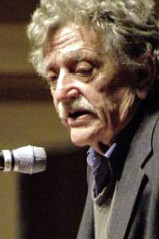
Kurt_Vonnegut_at_CWRU
Kurt_Vonnegut_at_CWRU (Photo credit: david_terrar)

I’ve been reading Kurt Vonnegut again. It is a bad habit I started as a teenager. When I began reading Vonnegut, I was a classic example of a depressed teenager, or at least that was how I saw myself.

Looking back, I realized I had many reasons to be sad. Extremely sad, even. A friend had died in a motorcycle accident when a car pulled in front of him in our own neighborhood, and then my uncle, who was 25 years old, died in a fire that consumed the mobile home he was living in. Of course, a few other bad things happened, too, and the world just seemed a little crazy to me, not fair at all.

My confusion was confounded by the fact that I would often hear family members ask one another, “Do you think someone is trying to tell you something?” They searched each devastating event for a message from God. If something bad happened, it was because we had done something wrong. At church, I learned that all the pain, all the trials, and all the trauma was part of God’s plan, even if no mortal could make heads nor tails out of the plan. I hadn’t read Kierkegaard yet, but I was told to take a “leap of faith,” and then I was thrown off a cliff of faith.

Søren Kierkegaard (Copenhague)
Søren Kierkegaard (Copenhague) (Photo credit: dalbera)

So, around that time, I read about Kurt Vonnegut’s unlucky sister. In the prologue to Slapstick, he told of how while his sister, Alice, was dying of cancer, her husband, who was to take care of their children after her death, died on “the only train in American railroading history to hurl itself off an open drawbridge.” It was bad luck—bad enough to make you feel a little depressed.

But Vonnegut always made me feel better about things. He said, “Since Alice had never received any religious instruction, and since she had led a blameless life, she never thought of her awful luck as being anything but accidents in a very busy place.” Although I have received prodigious religious instruction and led a life full of blame, that one line has gotten me though many dark moments.

Over the years, I’ve heard many people tell me that bad things were part of some tortuous plan by some deity or other, I’ve heard that children are only on earth as a “loan” from God, and I’ve heard that God won’t give us more than we can handle. It seems to me that people routinely get more than they can handle. Many people die from stress-related illness or suicide, brought about by despair and a massive inability to cope with life’s tribulations.

Ah, but the people who didn’t survive just didn’t have enough faith to get by. The message I got from this was: “Be strong—or God may kill you.” If I had no faith in the purely accidental nature of bad luck that I learned from the Vonneguts, I am not sure I could have survived my life, which really only has the normal amount of sorrow and trauma. I haven’t been spectacularly unlucky, even by first-world standards.

Thanks to some of the interpretations I have heard of the meaning of traumatic events, I get a little nervous when anyone starts talking about making meaning of suffering. I’m quite happy to believe that suffering is just one of the vagaries of an existence fraught with peril. According to a paper by psychologist Robert Neimeyer and his coauthors, people have an intense need to “make meaning” after an extreme event disrupts their life narrative. Through a process of making meaning, individuals are able to restore a coherent narrative of their lives.

Part of the problem, it seems, is that most people believe the world has a certain moral order, and that people who are good will be rewarded with positive outcomes. So, when bad things happen, we will surely ask, “Why me?” This is a question Alice Vonnegut never asked herself, according to her brother, anyway. The horrible luck she had did not interrupt her narrative because her narrative was one of randomness and accidental events.

Regardless of what narrative one tells regarding the moral order of the universe, many people do see their own moral or spiritual growth as a result of suffering. Indeed, when we meet young people who are self-satisfied and callous, we often think that they will grow as they meet with grief and loss, and that growth will bring wisdom. It is good to know that our loss can make us better people, but I can’t think of a time when I would not give up my personal growth in order to have a loved one restored.

It seems somehow wrong, ethically wrong, to look toward loss as an opportunity for growth, but we do not seem quite so bothered by looking backward to a loss as a catalyst for growth. Herein lies some of my discomfort with focusing too clumsily on making meaning—it almost implies approaching loss by asking, “What can I get out of this?” Alternatively, it invites people to celebrate what they gained from loss. This, in itself, can create moral distress.

To be sure, psychologists such as Robert Neimeyer emphasize accompanying the grief-stricken on their own journey without guiding them down any particular path. People will, naturally, have to determine what their loss means and also what meaning they assign to life after their loss. If they fail to find any meaning, they may lose their lives all together.

In the quest for meaning, though, I hope we can accept that we live in a world full of hazards, and they do not affect us in any rational order. It turns out that some really awful people live rather charmed lives, and the purest and most compassionate people in the world suffer, though not always.

If we have the strength, we put one foot in front of another one more time. And, maybe, once again.

Montaigne: We’re all animals

I have a bad habit of speculating about what animals, usually my dog or someone else’s pet, are thinking. This leads people close to me to accuse me of anthropomorphism. They say I assume animals experience the world in the same way I do without any real evidence to tell me what kinds of  “thoughts” animals might have.

And it is true; I have no way to verify what animals are actually thinking, but I don’t have any reliable way to know what anyone is thinking, so I go about my day assuming animals, especially mammals, experience life more or less as I do, even if they can’t express it with language. I happen to think those of us who make this assumption are kinder than those who don’t. And if we must make assumptions, anyway, we might as well make assumptions that increase kindness in the world.

In Political Emotions, Martha Nussbaum turns the tables on the critics of anthropomorphism. Rather than accusing people of projecting human emotions onto animals, she questions why humans are so insistent on denying that human and nonhuman animals share some emotional experiences. Rather than anthropomorphism, she says, we are guilty of anthropodenial.

Humans have a long history of placing themselves closer to angels than to other mammals. In fact, many humans see themselves as a sort of angel in waiting. We separate ourselves from other animals by drawing a supposed bright line between ourselves and animals. What’s more, humans have a tendency to separate themselves from other humans by projecting animal qualities on others. Humans in despised and marginalized groups are said to be vicious, savage, smelly, dirty, shameless, and stupid. Being no better than animals, members of such groups are often treated much worse than “angels in waiting.”

Nussbaum’s description seems radical in some ways, but the distinction between writers and thinkers who deny the shared experience of human and nonhuman animals and those who embrace the similarities is ancient. Writing in the 16th century, Michel de Montaigne

Michel de Montaigne wrote of his condition tha...
Michel de Montaigne wrote of his condition that, “I am at grips with the worst of all maladies, the most sudden, the most painful, the most mortal and the most irremediable. I have already experienced five or six very long and painful bouts of it.” (Photo credit: Wikipedia)

made many of the same points as Nussbaum. He notes, first, that the humans are the “most wretched and frail” of species yet also the proudest.

He says the human animal “attributes to himself divine qualities, withdraws and separates himself from the crowd of other creatures, cuts out the shares of the animals, his fellows and companions.” And he challenges the assumption, asking, “From what comparison betwixt them and us does he conclude the stupidity he attributes to them?” He points out that we eat, reproduce, protect our young, and generally try to survive right along with all the other animals. Of course, one of the most important similarities is the way we deal with pain, both physical and emotional. He says, “Our crying is common with the greatest part of other animals, and there are but few creatures that are not observed to groan, and bemoan themselves a long time after they come into the world.”

We suffer and bemoan our fate right alongside our animal companions on the earth. While we may wish to bring the heavens under our feet, as he says, we are lowly animals seeking comfort and refuge from fear, hunger, and loneliness. And if humans are wont to declare themselves superior to animals based on an alleged superiority and favor from God, humans are just as likely to attempt to declare themselves superior to other humans—largely by comparing those humans to animals in an effort to degrade them.

Thus, members of other cultures, skin colors, or practices are seen as being savage or beastlike. Their animalism is evident by their alleged smells, filth, aggression, or unchecked sexuality. Not one to shirk from the most extreme cases, Montaigne examines cultural views of cannibals. He describes in gruesome detail the methods of war, capture, and torture reputed to some classes of cannibalistic humans. After Montaigne has thoroughly disgusted his reader, he declares, “I am not sorry that we should here take notice of the barbarous horror of so cruel an action, but that, seeing so clearly into their faults, we should be so blind to our own.”

Without shirking from the most horrifying practices of cannibalistic cultures, Montaigne then turns to examine his own culture. He says, “I conceive there is more barbarity in eating a man alive, than when he is dead; in tearing a body limb from limb by racks and torments, that is yet in perfect sense; in roasting it by degrees; in causing it to be bitten and worried by dogs and swine . . . than to roast and eat him after he is dead.”

He then tells us of a case where cannibals are brought into “civilized” society and shown the pinnacle of human achievement. After they have seen all the finery, the king asked them what they most admired. They said “that they had observed, that there were among us men full and crammed with all manner of commodities, while, in the meantime, their halves were begging at their doors, lean, and half-starved with hunger and poverty; and they thought it strange that these necessitous halves were able to suffer so great an inequality and injustice, and that they did not take the others by the throats, or set fire to their houses.”

Be kind to animals. Even human ones.

Tea Party and the “Mask of Anarchy”

Percy Bysshe Shelley, by Alfred Clint (died 18...
Percy Bysshe Shelley, by Alfred Clint (died 1883). See source website for additional information. This set of images was gathered by User:Dcoetzee from the National Portrait Gallery, London website using a special tool. All images in this batch have been confirmed as author died before 1939 according to the official death date listed by the NPG. (Photo credit: Wikipedia)

I don’t think I’m the only one to notice that Percy Bysshe Shelley‘s “Mask of Anarchy” seems amazingly relevant to current efforts to suppress the voices and will of workers around the world. So, I’ve taken the poem almost verbatim, made a few textual changes, and changed the names of the politicians to the names of Tea Party members and others in the Republican party. For more info on the poem, see The Guardian‘s partial explication.

Here is my take:

As I lay asleep in Houston, Texas
I heard a voice declare war on us,
And with great power it led me
To walk in visions of Poetry.
I met Murder as the widows began crying—

He had a mask like Paul Ryan—
Very smooth he looked, yet grim;
Seven blood-hounds followed him:
All were fat in the savage crew,

For one by one, and two by two,
He tossed them human hearts to chew
Which from his wide cloak he drew.
Next came Fraud, and he had on,

Like John Boehner, an ermined gown;

Official portrait of United States House Speak...
Official portrait of United States House Speaker (R-Ohio). (Photo credit: Wikipedia)

His big tears, for he wept well,
Turned to mill-stones as they fell.
And the little children, who

Believed him to be true,
Thinking every tear a gem,
Had their brains knocked out by them.
Clothed with the Bible, as with light,
And the shadows of the night.

Like Perry, next, Hypocrisy
On a crocodile rode by.
And many more Destructions played
In this ghastly masquerade,
All disguised, even to the eyes,

Like Bishops, lawyers, peers, and spies.
Last came Anarchy : he rode
On a white horse, splashed with blood;
He was pale even to the lips,
Like Death in the Apocalypse.

And he wore a kingly crown;
And in his grasp a sceptre shone;
On his brow this mark I saw—
‘I AM CRUZ, GOD, KING, AND LAW!’

With a pace stately and fast,
Over Texas land he passed,
Trampling to a mire of blood
The adoring multitude.

And with a mighty troop around
With their trampling shook the ground,
Waving each a bloody sword,
For the service of their Lord.

And with glorious triumph they
Rode through Texas proud and gay,
Drunk as with intoxication
Of wine of wanton destruction.

And each dweller, panic-stricken,
Felt his heart with terror sicken
Hearing the tempestuous cry
Of the triumph of Anarchy.

For from pomp to meet him came,
Clothed in arms like blood and flame,
The hired murderers, who did sing
‘Thou art God, and Law, and King.

‘We have waited weak and lone
For thy coming, Mighty One!
Our purses are empty, our swords are cold,
Give us glory, and blood, and gold.’

And Anarchy, the Skeleton,
Bowed and grinned to every one,
As well as if his education
Had cost billions to the nation.

When one fled past, a maniac maid,
And her name was Hope, she said:
But she looked more like Despair,
And she cried out in the air:

‘My father Time is weak and gray
With waiting for a Change this day;
So long as Anarchy rages on still,
The world awaits a reborn will!

‘He has had child after child,
And the dust of death is piled
Over every one but me—
Misery, oh, Misery!’

Then she lay down in the street,
Right before the horses feet,
Expecting, with a patient eye,
Murder, Fraud, and Anarchy.

And the prostrate multitude
Looked—and ankle-deep in blood,
Hope, that maiden most serene,
Was walking with a quiet mien:

To an accent unwithstood,—
As if her heart cried out aloud:
‘People of conscience, heirs of Glory,
Heroes of unwritten story,

‘Rise like Lions after slumber
In unvanquishable number.
Shake your chains to earth like dew
Which in sleep had fallen on you—

You are many—they are few.
‘What is Freedom?—you can tell
That which slavery is, too well—
For its very name has grown
To an echo of your own.

But change rose as a two-headed monster
Each head struggling to devour the other
But Hope nourishes the stricken half
And leaves Gold with a dark epitaph

“Let not this monster rise again.
Squelch the greed that lies within.”
We are not, as impostors say,
A shadow soon to pass away.

We ‘Rise like Lions after slumber
In unvanquishable number—
Shake our chains to earth like dew
We are many—they are few.’

Nussbaum and Rand on the Politics of Love

I’m currently reading Martha Nussbaum’s Political Emotions: Why Love Matters for Justice. Love is an important focus of the book, but it is certainly not the only emotion that Nussbaum considers important to a minimally decent society. Still, love (and its relevant associate, compassion) is an integral part of a stable and humane democratic society.

English: Photograph of Martha C. Nussbaum take...

Nussbaum suggests that it is entirely appropriate for governments to encourage the development of political emotions that are absolutely necessary for a functioning society. Of course, totalitarian, repressive regimes often rise to power on waves of extreme patriotism coupled with xenophobia and violent anger. This is a risk of the state cultivating emotions, but it is also likely that inappropriate emotions arise because we shirk our duty to cultivate the correct emotions. Who decides which emotions are correct? Why, we political liberals, of course. Nussbaum is more optimistic than I about the ability to create a state that will encourage the appropriate arts and literature to cultivate emotions that will engender empathy and promote democratic feeling. Still, we are obligated to make every effort to counter those who would work to destroy both compassion and democracy.

Nussbaum recognizes the potential for paradox in her claim, but she defends her position with depth and detail. The fact that I agree with both her goals and method make it quite easy for me to follow along and hope, against all odds, that is possible to create a more decent society than what I currently see around me, even if I feel we must go it alone without the full support of government.

Ayn Rand

But all this talk of love got me thinking of Ayn Rand, of course, as many things these days get me thinking of Ayn Rand. She said that we should be selfish and never sacrifice ourselves to others. In contrast, many of us have foolishly believed that to love someone was, in fact, to be willing to sacrifice ourselves for his or her well-being. On this point, I think Ayn Rand was able to explain herself quite clearly. When asked whether we shouldn’t be selfless in our romantic relationships, she said,

When you are in love, it means that the person you love is of great personal, selfish importance to you and to your life. If you were selfless, it would have to mean that you derive no personal pleasure or happiness from the company and the existence of the person you love, and that you are motivated only by self-sacrificial pity for that person’s need of you.

She makes a good point. We sacrifice for those we love because we value them so much that their loss is a personal loss to us, and their suffering is a suffering we share. We do not love out of duty; we love for the pleasure it brings us.

For Rand, altruistic concern for strangers entails a denial of self-satisfaction and an indenture to others. By living for the needs of others, we deny our responsibility to determine and seek our own needs. It does not occur to Rand, as it does to Nussbaum, that is possible to value other humans with a love that extends beyond our realm of personal contact. It is possible that I want to preserve the lives of strangers thousands of miles away because I value them, even if abstractly, to the point that their suffering causes me suffering.

I don’t want to live in a world where millions of people starve to death each year, and I do not believe they are starving because of the poor choices they have made. I believe they are starving because of structural economic violence against them. In many cases, the world’s resources have been stolen by brute force (did farmers and fishers in Africa foolishly give their land to oil companies?). Poverty, addiction, and disease are largely a result of violence against people who are not recognized as being fully human, fully deserving of respect.

We don’t have to accept this reality. As Nussbaum says, “We should surely not assume that the form emotions take in the corporate culture of the United States reveals a universal and timeless truth about how things must be.” No, we can work to ensure that our moral imagination can perceive other human beings as beings worthy of respect, dignity, and, yes, love. If we seek to respect ourselves, we must demand respect for all.

Love is possible.

Patients’ Rights Survey

Patients’ Rights Survey

Please take my patients’ rights survey. I am trying to learn about how patients (and potential patients: everyone) feel about informed consent, financial disclosure, medical research, and end-of-life decisions. There are only 20 questions and it is anonymous.

I will be most appreciative of all responses.