A philosopher of mind,
It doesn’t matter who,
But it was Daniel Dennett,
Made a point of describing
Disembodied consciousness,
Or dissociation,
To prove that animals might
React physically to pain
Without being conscious of it.
He illustrated this with the case of
Children who dissociate during
Sexual assaults. *
In a seminar, another prominent male
Philosopher turned to another and said,
“I dreamed I raped and murdered your wife.
Do I owe you an apology?”
A female philosopher left the room.
Thought experiments are expected to
Be free and provocative,
But haven’t we experimented enough
With thoughts of violence against
Women and girls to know where they lead?
*(Dennett said the child thinks, “’I’ am not undergoing this pain, “she” is.”)
The Stoics all counsel the same.
Contemplate life and accept
Death without too much disruption.
They counsel the same when
You are overwrought, but
Flood you with a tsunami of tears
When their turn comes.
Seneca condemned his own sobs;
Confucius angrily defended his,
And I have forgiven them both.
Their failure is my comfort as my own
Tears pour over your last letter.
We have such unfounded confidence that
The future will be like the past that
We are constantly disappointed in the
Present. The future betrays us daily.
So I can’t be blamed for thinking you’d
Be here still—as you always were.
Thousands of observations told me
You were a survivor and, besides,
You promised you’d never leave.
My imagination has expanded
Regarding the regularity of nature,
But I still look for you in the
I can no longer imagine
A lone traveller discovering
A trunkless tribute to
Ozymandias.
A contemporary sojourner
Would discover miles-long
Queues leading to a monument
Adorned with rubbish and graffiti.
Our seeker, surrounded by the
Selfish brandishing selfie-sticks
And unrestrained egocentrism,
Would only be repulsed by the
Living teeming mirror
In the desert.
A half submerged visage
Peers through piles of plastic
To invoke the ancient warning:
“Behold these works, indeed,
And do remember to despair.”
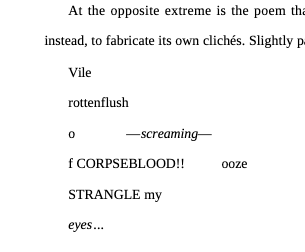
The venerable X. J. Kennedy used a poem about “vile rottenflush”
to illustrate bad poetry in his seminal textbook, Introduction to Poetry.
The poem, he explains, was submitted to the equally venerable Paris Review, but he does not credit (blame?) the author.
The poem about vile rottenflush, he clarifies, is too personal
and subjective to speak to anyone other than the person who wrote it.
He says, “the author has vented personal frustrations upon words,
instead of kicking stray dogs.”
Who am I to question the wisdom of someone
as accomplished as X. J. Kennedy?
I only know that I remember the phrase “vile rottenflush”
four decades after first hearing it. Also, I think the author of “vile rottenflush”
had witnessed a death of someone much loved, and anyone who has watched
the most cherished people in their lives die might understand the poem, after all.
I think this because the poem also mentions “corpseblood” and “ghastly stench.”
No one forgets the smell of a soul leaving the body.
And no one forgets what they see when life is flushed away.
Perhaps “rottenflush” was a novel way of avoiding the now
clichéd references to “putrefying flesh.”
Perhaps it is a way of reminding the readers
That our blood will cease to flow, pulse, and pump,
Only to be left to pool, drip, and stink.
The author of “vile rottenflush” might be accused of being too direct,
But not too personal. Which of us will not overwhelm
Post mortem viewers and handlers with our own
Ghastly stench, reducing them to cries or horror
As they see their fate clearly in our eyes?
America is a land of hyphenated identity—
A melting pot, as it were, of cultural identity.
African-Americans and Asian-Americans, of course,
And gay-, Muslim- and Native-Americans are a force.
But Americans are also Irish, Welsh, and Scottish.
We have Germans and Swedes, but no Americans are English.
Strange, the English travelled to America to set up colonies
Take the land, kill a few million people, and do business in tea.
The English brought the Africans and many other immigrants,
But not one person, it seems, became and English-American.
Today’s Americans think the English lost the Revolutionary War;
The winners were English, too, but no one remembers that far.
So the white Americans who remain are of European descent,
But they are simply called American with no adornment.
Only if they want to declare they come from the original colonists
Will they call themselves Anglo-American with a nod and a sniff.
You sit behind your desk with all the power in the world
That can be contained by these four walls.
You can humanize the experience for whirled
Emotions or you can pretend to be master of laws
You take the latter approach, of course.
Without making me miserable, your life has no meaning
Feeling small, you mount a high horse
And squash any dignity you see gleaming
You’re perfunctory, it goes without saying,
But must you also be so sanctimonious
While you are pedantically conveying
Your need to make this acrimonious?
You have the power over me now, it’s true,
And you know I can’t answer back.
For the time being, I have to eschew
My insults, but I plan a counter attack.
When you get home, you have only the dog to kick,
But you’ve joined me with the anonymous masses
You needled me when I was in a state of near panic,
But we’re now on level ground, paying equally for our trespasses
You’re a one-person version of the Stanford Prison Experiment
And I understand. I’ve also had moments of totalitarian zeal
Our quiet desperation leads us to act to other’s detriment
A momentary, flickering power is all that we wield
When I look at you, I stare into the mirror
We share an existence with no real significance
In this brief power struggle, all becomes clearer
I’m the boulder to your vain Sisyphus
But outside the glare of white walls and white lights
I forget your eyes, your voice, and your power
My planned attack fades like a lost, loveless night
And I sink into the despair of light’s last hour
Someone has found a reason to love you, I imagine
And some fools care about me for one thing or another
This is all we have or will have, my soulless friend,
And that is just enough, or is it?, I wonder.
We use cookies to ensure that we give you the best experience on our website. If you continue to use this site we will assume that you are happy with it.
You can revoke your consent any time using the Revoke consent button.

 A philosopher of mind,
 We have such unfounded confidence that
 I can no longer imagine
 The venerable X. J. Kennedy used a poem about “vile rottenflush”
 America is a land of hyphenated identity—